Showing posts with label BUSINESS. Show all posts

Thursday, May 12, 2011

Our Iceberg is Melting by John Kotter & Hogler Rathgeber

I read this book, after strong recommendation of my professional guide.

The book is in the fable form, and it reminded me of book 'Who Moved My Cheese?' by Spencer Johnson.

Though I have read the ideology of John Kotter, in one of his Harvard Press Articles, listing out his 8 steps Change Management Press, but fable is more enjoyment, less stress and more insight.

So, in general it was fabulous book on Change Management, which is becoming increasingly important, as global forces are making businesses and all other spheres of life fast changing. It actually reminds of the phrase ' Changing is Changing So Fast!!' in the book 'Future Shock' by Alvin Toffler.

Still, I think most of the management theories are unable to answer one vital question 'How to create a change, when its not actually not a zero sum game, but at the same time, also to an extent a zero sum game?' The typical and extreme case is 'Downsizing'.

And, I couldn't get the answer to this question in this book too.

But, in total its a good methodology and book to follow in any Change Management Process.

One can refer to the site of John Kotter, http://www.kotterinternational.com/Default.aspx for further details on the book and its methodology

Tuesday, May 10, 2011

Reengineering the Corporation by Michael Hammer & James Champy


This book was written by the authors, who coined the term 'Business Process Reengineering', which has been a buzz word since 1990's and still is.

Though this book as written in 1990's and then rewritten in early 2000's, but the approaches discussed in it are quite relevant.

The best thing I liked about the book is how the authors took me through the journey of Industrial Revolution, Adam Smith's Factory Model, Ford's Assembly line model and then back to Process based industry.

I think, this book is must read for any corporate manager. While many of the approaches discussed, may not be immediately applicable in one's environment, but it surely will broaden the perspective of readers

More works of Michael Hammer can be explored at his company's website http://hammerandco.com/

Saturday, December 11, 2010

Ambani & Sons by Hamish McDonald

This is another book by Hamish McDonald, the author of 'The Polyester Prince'

The Polyester Prince was banned or is still banned in India since its publication around decade ago. But, you can easily find the pirated copies of it on road side in all the metro cities of India.

Anyway, this sequel has made it easy for the readers to buy the story of Ambani's legally. According to readers, the story is 80% the story of The Polyester Prince, with 20% addition.

The earlier book was focussed on rise of Dhirubhai and covered it till 1998. While this book covers till mid 2010. The new chapters focus more on now two seperate empires of Anil & Mukesh.

And after reading it, I can very well understand why the earlier book was banned. And I think, Hamish is in habbit of writing such open and provocative books, which are banned in the focussed countries.

But, if you want to understand evolution of Business in India post Independence, this is must read

Tuesday, March 2, 2010

Aol.com by Kara Swisher

I read this book almost after the decade, it was published. I was apprehensive, whether should I or shouldn't I read this book. But, i went ahead.

This book gives us a snapshot of internet industry in its infancy stage. More over it tells us about the AOL-America On Line- its birth and rise.

I recommend this book to all the netizens as well as to all the brand managers. It gives us a classic case of brand management.

Thursday, August 2, 2007

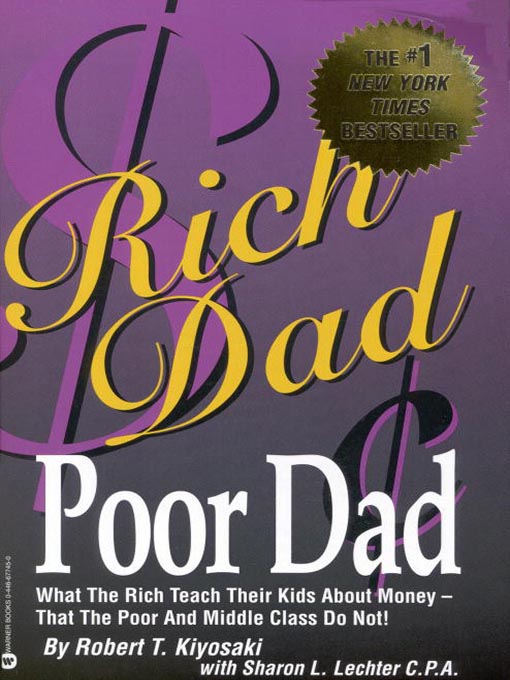
Rich Dad Poor Dad


Author: Robert T. Kiyosaki

Do you hate to work for money?

Are you broke at the end of every month?

Do you believe life has much more to offer to you than it has already done in terms of riches and luxury?

Do you want to REALLY get rich?

Then go ahead, read this book.

I read this book recently and it breaks all the myths about getting rich. It radically changes the mindset our culture, our peers and our parents try to instill in us. The mindset that the ONLY way to make more money or get rich is to become more education, get more academic degrees, work hard to earn more money and the list goes on.

Robert starts with comparing the teachings of his poor dad (his biological father) and the teachings of his rich dad (father of his friend). He compares the teachings of both of his fathers and tries to explain to the readers how each kind of teaching impacts anyone's path to become rich and free from "rat race".

Robert teaches in this book about financial IQ, about how to build assets, how to free yourself from the rat race. He gives tremendous examples on how to earn money and get rich by investing in real estate. He gives his own personal real time examples to show how he made money work for him rather than work for money.

The book is a total mind opener and gives valuable insight on how rich people make money work for them rather than work for money.

A must read if you really want to make big money!

Recommendation: 10/10

Tuesday, July 24, 2007

Positioning - The battle of your mind


"Al Ries and Jack Trout on Positioning:
The Battle for Your Mind", the book that launched the concept of positioning and caused a major paradigm shift in marketing thinking, define positioning as how you differentiate your product or service in the mind of your customer or prospect. It is where your product or service fits into the marketplace in relation to your competition based on the perception of your customers and prospects.

In this book, Al Ries and Jack Trout describe how positioning is used as a communication tool to reach target customers in a crowded marketplace. Jack Trout published an article on positioning in 1969, and regular use of the term dates back to 1972 when Ries and Trout published a series of articles in Advertising Age called “The Positioning Era”. Not long after, Madison Avenue advertising executives began to develop positioning slogans for their clients and positioning became a key aspect of marketing communications.

Book Description
Positioning, a concept developed by the authors, has changed the way people advertise. The reason? It's the first concept to deal with the problems of communicating in an over communicated society. With this approach, a company creates a 'position' in the prospect's mind, one that reflects the company's own strengths and weaknesses as well as those of its competitors. Witty and fast-paced, this book spells out how to position a leader so that it gets into the mind and stays there, position a follower in a way that finds a 'hole' not occupied by the leader, and avoid the pitfalls of letting a second product ride on the coattails of an established one. Revised to reflect significant developments in the five years since its original publication, Positioning reveals the fascinating case histories and anecdotes behind the campaigns of many stunning successes and failures in the world of advertising.

Introduction

The average American consumer is exposed to $376 worth of advertising per day over 365 days. With this enormous volume of communication, the only way to score big is to be selective and concentrate on narrow targets through Positioning. It’s about how you position a product in the mind of your prospect.


Do you know how your product or service is positioned in the minds of your customers or prospects?


Your company's position in the market place evolves from the defining characteristics of its product or service; namely, pricing, quality, service, distribution and packaging. It is critical for you to define their market position. If you do not, your competitors will do it for you. Through the initial strategy process or a stand-alone market analysis, at Image Perspective, we seek to discover your unique positioning. Once it is defined, we exploit it to secure a memorable position in the mind of your customers or prospects.


When positioning your company, it is important to consider the following elements: the attributes that differentiate your product or service in the market place, your competition and the demographics of your target market.

The first book to deal with the problems of communicating to a skeptical, media-blitzed public, Positioning describes a revolutionary approach to creating a "position" in a prospective customer's mind-one that reflects a company's own strengths and weaknesses as well as those of its competitors. Writing in their trademark witty, fast-paced style, advertising gurus Ries and Trout explain how to:

- Make and position an industry leader
- Position a follower so that it can occupy a niche not claimed by the leader
- Avoid letting a second product ride on the coattails of an established one.
- Positioning also shows you how to:
- Use leading ad agency techniques to capture the biggest market share
- Build your strategy around your competition's weaknesses
- Reposition a strong competitor and create a weak spot
- Use your present position to its best advantage
- Choose the best name for your product
- Determine when-and why-less is more
- Analyze recent trends that affect your positioning.

Ries and Trout provide many valuable case histories and penetrating analyses of some of the most phenomenal successes and failures in advertising history. Revised to reflect significant developments in the five years since its original publication, Positioning is required reading for anyone in business today.

Sunday, July 22, 2007

Lair's poker


Lair's Poker by Michel Lewis

Just finished reading Lair's Poker. The book is about the author's days as a bond trader with Solomon brothers, and how the rise and fall of solomon brothers and the bond market sort of co-incided with his career. Lair's Poker is a game where each player holds a dollar bill in his hand and each one makes a claim about the count of a particular number. E.g four 7s i.e there are four 7s in the numbers of the dollar bills of all the players combined. The next guy can either up the number or call a new bid for another number and the game goes on till some one challenges the call made by a player.

Apparently it was the favourite game of Bond traders on the solomon floor.
An interesting and gripping book about the life of a trader during the good old days when rules were not so strict. Narated in a very lucid manner without any unnecessary jargon. Makes an interesting read even if you have no intentions of being an i-banker.


Wednesday, June 27, 2007

The Fortune at the bottom of the Pyramid


Author: C K Prahlad

Publisher: The Wharton Press

A real Paradigm Shift about, what Market Is? Shows you how the Poor People, People at the Bottom Of the Pyramid (BOP), who were earlier neglected by the Big Corporate, are now considering them for future growth. It makes you believe, with practical case studies, how you can generate demand with sustainable profits by tapping into BOP. It’s no Philanthropy serving the BOP, its serious Business now and future growth will come from those sections only.
The BOP market is much more challenging and demanding than the high end markets, since the adversities there are much more. Companies have to clearly understand BOP requirements and bridge all the gaps between them by innovation. This could be by micro financing, improving distribution, cutting overheads, Introduction of low volume packs, generating awareness. Author shows how the solutions to BOP markets can be scaleable across geographies and thus generates sustainable markets.Author backs up his claims with proof of success, through real time case studies, and that’s the book's strongest point. Though the other day I had a talk with one of the ITC guy according to him e-choupal is still not in profits till now and ITC is not bullish on it, but otherwise claimed by the author. But this doesn’t affects, since the logical coherence shown by the author makes anybody believe it is possible.

Friday, June 15, 2007

Losing My Virginity - Richard Branson


Losing my Virginity,,, Screw it Lets do it! Only one businessman can be that blatant. Yes, its Mr. Richard Branson, the brash, dynamic, flamboyant British Business Tycoon. This book is his Autobiography and guys, its a pleasure to read. Yeah, its fun and infomative.


It starts from the very childhood of Mr.Branson and chalks the path of how he built up his Mega- Virgin empire. You have to admire the guts of this guy. He is extravagant, flippant and a playboy, but he is one hell of an entreprenuer. He is the ideal entreprenuer, risk taking ability being his best quality.


In the book Branson tells us about how he started a new magazine called STUDENT while he was studying. How he used innovative tactics to distribute and market it. Then how he started Virgin Records which was a mail order business first, then he started the first Music experience stores. At that time music stores were dull and boring. Branson created a Music theme store, where you could listen to music, sit for long time and have fun. Then he signed up Mega stars for his Virgin label records. He also diversified into travel, entertainment, retailing, media, financial services, and publishing. He also gives details about his flaboyant, flagrant lifestyle, which is quiet entertaining. Also, details about his amazing Baloon expeditions across Atlantic and Pacific , his near death experiences. His life has been one hell of a ride and he shares it quiet openly. The best part is his detailing about how British Airways tried to crush his airline and how he fought back and survived.


This guy has style and guts. One incident states how he encountered a problem for his idea of Virgin branded railway bogies - how a person had stated that Branson could not start a thing like that untill he was alive. Branson took up the challenge and did it.


Though Branson is not a great writer, but he is a good story teller and hence the book is very interesting. Go for it. It will teach you what a person has to go through to reach those heights, the struggle to be faced and the guts you need to reach there. Its a great read.

Saturday, June 2, 2007

McDonald's: Behind the Arches

by : John F. Love

If you have ever wondered what happens behind the scenes at every Mc Donald's restaurant this is the book for you. How does Mc Donalds have your order ready by the time you drive through from the order mike to the pick up window? What is the story behind the Clown Ronald Mc Donald and why is he so popular today (by some records he is second in popularity in the US only to Santaclaus) as the Mascot of Mc Donalds? This is the book to read.

The books starts when Mc Donalds was just a fledgling operation , a single store sun by the Mc Donald brothers who have discovered a better, faster and a more efficient way of running a Fast food Joint and then takes you on a Roller coaster ride of the history of Mc Donalds from day one till about 1986 when the books was originally published and Mc Donalds became the huge monolith that it is today. The evolution part is really interesting, for example why and how do Mc Donalds French fries taste the same all around the world, and what is the secret behind those french fries, with just the right amount of crispiness, the soft insides and the tasty golden crust. did you know the Mc Donalds fries are dipped in a light sugar solution just before frying to give that golden brown color.

The book gives you a good insight into the mind and thinking of founder of modern day Mac Donald's - the indomitable Ray Kroc and the hundreds of suppliers and franchisees who made Mc Donalds the success that it is today. The author is of course unabashedly positive about the company and the people behind the scenes but I guess that is the compromise you have to make if you want the inside view of such a business. After all why should people speak to you if you are going to write a critical commentary of their business.
But critical or not, the book is an immensely good read and with 450 + pages in pretty much detail. Should be a must read for anyone entering into a franchising / food business.

For Marketing fanatics the pages present very good lessons in how Mc Donalds initially stumbled and how it got back on track when the chain expanded internationally customizing to just the right amount to local tastes.

PS: This is not from the Book , Also have a look at the regional Mc Donalds dishes and the amount of customization they have done here. Copy of the original post here.

Saturday, May 26, 2007

THE McKINSEY WAY


by Ethan M Rasiel

Whenever I think of consultancy firm; the first name that strikes to my mind is “McKinsey”. Why is this company-a dream company for most of the MBA’s? The only answer to this question is MK's style of working and ability of its solutions to get things work for their clients, isn’t it? Believe me this book is very easy to go through as it used best possible & simple language and well pointed anecdotes.

This book is all about the way MK handle its business. However author claims that it is very easy for you to use MKW in your own business or profession, and I found it realistic. The way author has written this book is fantastic. The book has been divided into parts.

How MK think about the business problem
How MK work to solve the business problem
How MK sell its solution
Life at MK
The cardinal rule that McKinsey-ites can never forget is MECE (Mutually exclusive collectively exhaustive). This is the best thing; however most of the time gets ignored by non- McKinsey-ites; that’s what I claim. Whenever you work on anything you should keep this MECE in your mind, this helps you to be equipped with all possible ways towards the solution to any kind of problem and reduce the confusion by avoiding repetition. While studying any business problem McKinsey-ites study it in structured manner. Indeed this helps you to boil down at the crux of the problem; it is essential part as your solution needs to fit the clients’ requirement. Putting the client first is one of the most important key to successful client services. McKinsey-ites form the initial hypothesis, which determines the approach towards solution. So keep in mind that McKinsey-ites never go with blank slate, they have their structured approach to think about business problems, what do you do? The next thing that book talks about is 80-20 rule, which is one of the best rules in management. This rule helps to expedite the solution process; as keeping this rule in mind you can get the 20% things (key drivers) which contribute 80% to the output and this makes it easy for the McKinsey-ites to keep the wheel rolling. I really love this rule.

Here comes the focus on marketing part of MK and how MK does it. Your solution becomes valuable only when you sell it to your clients. But author claims that “MK sells because MK markets”. At this juncture McKinsey-ites are expected to be prepared with their recommendations which must be supported by the facts & figures and outcomes from the research. Before going for any kind of research you need to streamline on particular issue, again use MK structure with MECE. If you forget doing this then you may end up collecting things, which may digress and confuse you. Gathering data for the research purpose plays vital role in coming up with best possible recommendation for the problem. Interviewer should possess the skills to absorb the required information in least possible time. Now let’s see how MK makes its way towards solution. Brainstorming is considered as one of the best way to solve the problem, same works with MK. At MK there is no bad idea, but this doesn’t mean that speaking on irrelevant topic will be entertained- beware of it. Each and every idea gets respect, which is the quality of good working environment which is conducive for the growth of the employees and in turn organization (hierarchy gets sidelined when McKinsey-ites are involved in brainstorming session). Book also focuses on the importance of the team; success of MK in the field of consultancy depends on the success of the team.

Now here comes the importance of all the presentations you have made in front of your class, boss or clients. Really presentation skills plays very important role in the career of any management trainee. Same is true at the MK. Book has given one kind of chart “Waterfall Chart”, as author says it is best way to present your data and I am fully agree with him. I have never before seen this chart and to my dismay it’s not available in MS Excel-2003; if anyone of you knows how to use it then please inform me. Internal communication at MK, working with client and its importance, this part is relatively slump. Last part is all about the life at MK and how to find the balance between work and life, one of the biggest management discourses.

One best thing about this book is that while reading the book you get the feel of how theories are implemented and customized to suit the organization and business.

Wednesday, May 16, 2007

Business Maharajas


By Gita Piramal

I came across this book in my second year of engineering. This was the time, when I recently got interested in business and management. So, the name itself enticed me. But, the book was expensive by the measures of any middle class student’s pocket money. So, I waited for three years till I joined the job. And with my first salary, I bought this book. And the investment was worth it. I really enjoyed reading it.

The book is very well researched work of Gita Piramal, who delved into the life histories of Indian Business Tycoons. It covers the life histories of following business houses of India:


  • Dhirubhai Ambani
  • Rahul Bajaj
  • Aditya Birla
  • R.P.Goenka
  • Brijmohan Khaitan
  • Bharat & Vijay Shah
  • Ratan Tata

Though the book focuses on the particular business men, but it covers all the major story of his clan. Every story starts with the family tree. Then it tells, who was the first major businessman of the family like JNT Tata of Tata’s, G D Birla of Birla’s. Also, it tells how each of the family made its fortune like Birla’s made it in trade of opium. Along with the particular family and businessman it gives glimpses of the communities and regions they originated from and worked in like Marwadi’s in the form of Birla’s, Gujarati’s in the form of Ambani’s, Tata’s in the form of Parsi’s ( people who came to India from Persia).


Dhirubhai Ambani

Dhirubhai Ambani belonged to very poor family, but he rose to great heights by his sheer hard work, shrewd conduct and burning ambition. He started his career in Turkey with the Oil Giant, but soon came back to India to start his own business. He started with textiles and reached to information technology. He was the first person to capitalize and demonstrate the power of IPO in India. He was also unpopular for sowing seeds of corruption to the grass root level. But this guy showed the unprecedented pace of success. Now his two sons Mukesh Ambani and Anil Ambani are governing his business. The name of the group is Reliance. It will be really exciting to see the vivid replay of his life in the form of movie ‘Guru’ by Mani Ratnam. More info about Dhirubhai Ambani could be found at http://en.wikipedia.org/wiki/Dhirubhai_Ambani


Rahul Bajaj

Rahul Bajaj, is a legendary entrepreneur, who created the first indigenous models of motorbikes in India. But, he is not first generation entrepreneur. He belongs to Marwadi community. He is known for creating and spearheading the two wheeler market of India via his company Bajaj Auto. The story tells us about the strikes it faced in the days, when Labour & Trade Unions were so strong that they can make or break the ruling party of the state. It also tells us about the Inspector Raj & License Raj era, where the quota was allotted to each and every factory under MRTP act. This was the result of mixed economy model India was following. According to Bajaj, he would have sold the legendary Bajaj Chetak at half the price and with the instant delivery. But, the prices were high and customers had to wait for months to get the delivery. This was because of the government policies.

Initially Bajaj’s collaborated with Piaggio, owned by Agnelli family (owners of Fiat ) of Italy for producing Vespa scooter, which was instant hit. But, after few years due to misunderstanding between both the parties it broke off. And Piaggio collaborated with LML.

To enter motorcycles market and to strengthen it scooter market, Bajaj wooed Honda Motors of Japan. After months of meetings and negotiations Honda chose Munjal’s over Bajaj’s to form Hero Honda (now the biggest two wheeler producer in the world) for making motorcycles and collaborated with Firodia’s to form Kinetic Honda for making scooters. And finally, Bajaj collaborated with Kawasaki for making motorcycles.

With the onset of globalization in 1991, he eyed four wheelers market. He tried to strike a deal with Chrysler, Renault and Fuji. But the closest he could get was in the case of Ashok Leyland, which he finally lost to Hinduja’s.

Today he runs his empire with the help of his two sons Rajiv and Sanjiv Bajaj. And bikes Pulsar and Discover are giving the toughest fight to the foreign giants like Honda. I think they know Indian market better than others. In my personal case, I was in dilemma whether to buy Bajaj Pulsar or Honda’s Unicorn. Though Unicorn is smoother and better engineered bike but it lacked the most important thing required to attract Indian youth. ‘The Rugged Feeling’. So I chose Pulsar over Unicorn, and I feel the rush of adrenaline every time I drive it. More info about Rahul Bajaj can be found at http://en.wikipedia.org/wiki/Rahul_Bajaj


In total, this gave me the actual understanding of the works and lifes of businessmen, whom we daily hear about and quote. It also gave me understanding about the dynamics and history of Indian business market. It is one of the two books, which gave me revealed such truths and facts. The other one was ‘India Unbound’ by Gurcharan Das. Above all, it helped me to overcome the fear of reading ‘Economic Times’.

I recommend this book to anybody, who wants to understand the evolution of Indian business during and after independence.

I will add about the other businessman in next few days. Keep reading to get the updates.