Showing posts with label INSPIRATION. Show all posts

Saturday, March 8, 2008

CHICKEN SOUP FOR THE SOUL-MATES SOUL


By Al Raines
Undercover Utopia


Whoever had made the proverb ‘Don’t judge a book by the cover’ would have surely changed his mind if he came across a copy of Soul Search Engine by Al Raines. Honestly, this is the first book I have ever come across, which so crisply captures the whole essence of the novel with its cover page design. No, this book doesn’t have an expensive and glossy cover. Rather it is a sweet and simple cover.

Your foremost glance at the cover will give you the impression of the google homepage. However you will soon realize the title, hyper links and search button logos of this google page look-alike, actually read different. In bold colourful font this page is titled ‘Soul Search Engine’ which also happens to be the book title. The words keyed in this search box read ‘life times’. The indices or cross-sections of search offered are ‘time’ and ‘space’. You are given the options of an indepth infinite search or a simple nostalgic search on the whim. The web links indicate that you can savour your search through your five sense organs in terms of images, sounds, tastes, textures and fragrances. This book can’t be accessed with a mouse click as it is after all not an online book nor is its cover page a real web page. Just start turning the pages and read on- the novel will take you on a lovely trip down the ages.

Thematically Soul Search Engine is ‘a brief story of life, the universe and everything in ninety-nine pages: a story fourteen billion and thirty six years in the making’. The novel traces the history of the world from its inception till the modern times. It simultaneously unravels one of the greatest and touching tales of friendship through the story of two souls who strengthen their bond of friendship through the successive life times they share together. The front cover illustratively captures this very thematic concept.

Structurally the book is divided into three broad chapters: Disappearing Dinosaurs, Neanderthal Noon and Modern Men. The book opens with a prologue and is rounded off with an epilogue. A striking feature of the book is that the chapters are interspersed with diary entries by the protagonists of the book in cursive hand, lending an epistolary touch to the novel.

Those of you who think, “What’s the use of a book without pictures or conversations?” let me gladly inform you that Soul Search Engine has soft pencil shade sketches of dinosaurs, prehistoric men, cave sketches and artefacts symbolizing the modern age. The conversations between the protagonists are sometimes sad, sometimes funny, sometimes highly philosophical and sometimes so naïve, sweet and simple.

The protagonists of the novel are the adorable Stegy and Rex, who despite being poles apart become best buddies, in fact soul mates. They meet for the very first time when both are dinosaurs. They are reborn as Neanderthal men and later as modern men. As they bump into one another over several births they renew and develop on their friendship every time they meet.

Historical fact and fiction are harmoniously blended in etching out the characters and developing the plot. Stegy in his dinosaur birth is the Stegosaurus, very correctly described as large, plant-eating dinosaur with triangular plates on his back and spikes on his tail. Whereas Rex is a Tyrannosaurus Rex very aptly described as a carnivore with a massive skull balanced by a long, heavy tail. Despite being the largest predator alive he is pint sized when compared to the Stegosaurus. Stegy and Rex are however not the blood-curdling dinosaurs as shown in Jurassic Park and the Godzilla movies. They are docile rather than destructive. The only destructive dinosaurs in the book are the wily raptors. They retain their birds of prey instincts even when they reincarnate themselves later as prehistoric tribes thirsting for vengeance and finally modern terrorist warriors.

Neanderthal Noon beautifully chronicles the impact of the discovery of fire and the invention of the wheel. This chronicle may not however adhere exactly to factual truth- it reads more like a fictional chronicle. The wheel and fire rather have symbolic overtones in the novel and act as a medium to unravel the innate characteristic traits of the prehistoric protagonists Coznay (a reincarnation of Rex) and the Hider/ Finder (a reincarnation of Stegy). Coznay seems to have the vibrant energy and indomitable fiery spirit a fire seems to have. The Finder, the inventor of the wheel is the creative one. The way in which the Finder brings forth innovative changes to the world, he is indeed like the wheel of progress.

Prehistoric life is unraveled through sensuous imageries. There’s a lavish description of a feast in which ‘a veritable cornucopia of berries, nuts, roots, shoots and fruits’ are ‘all dressed up in myriad shades of leaves’. A prehistoric village in the shroud of the night sky is garlanded with small fires on tree tops and the paths between the huts. Rex in a latter life time while visiting New York City with all its dazzling lights fondly conjures up this rich visual memory.

In the last chapter of the novel Stegy and Rex come back to the world as Mikhail Gorky (who though an Army General wishes to save the defenseless) and Alex Baldwin (a self-made American millionaire who bets on the war). The concluding chapter is the most philosophical and nostalgic chapter of the novel with Stegy and Rex now with the analytical thinking capability of the contemporary man fondly reminiscence over the many lives they’ve spent together and how the world has changed over the years.

For a literary person Soul Search Engine may be a poetic and lyrical experience. For a historian the book may be a crisp synopsis of world history specifically the time frames of the Dinosaur Age, Prehistoric Age and Modern Age. For the philosopher the book brings forth a plethora of philosophical insights without promoting the teachings of any particular philosophers. For a person who believes in reincarnation it may be a delightful spiritual rendezvous.

Monday, September 24, 2007

Eleven Minutes

by Paulo Coelho
This is the second book of Paulo Coelho read by me. It was strongly recommended to me by one of my friends. But, I didn’t read it. I bought it to gift to one of my friends. After writing my name on it, when I gifted, and in the free time, I turned few pages, I was gripped by the story. So, I borrowed the gifted book from my friend, and read it.

In the start, it seemed to me as Paulo Coelho has resolved to write porn stories. But, slowly the things started changing. My perspective started changing. And I was thrilled by the story. The book is of around 270 pages, and I completed it in 2 days, reading it while eating, while travelling, and above all I compromised on my sleep.

In the first half, it became clear to me, that the story is actually having the base of the thought process, which governed ‘Alchemist’. All the same terminology, dreams, beginner’s luck, conspiracy of universe…. But, the difference was that it wasn’t any story of some traveler, shepherd, artist. It was the story of prostitute. I think , Paulo used his good knowledge of Brazil, his native place, to make the first half of the story. I was simply mesmerized how, the story line of ‘Alchemist’ be weaved into the story of Prostitute.

In the second half, the story took lot of turns. And it was mainly focusing on the very basic instinct known as sex, from woman’s perspective. The author, was trying to pass a message to the readers, that is something divine about sex. He tried to describe indirectly the female and male’s anatomy, the concept of sacred sex, the history of prostitution, the concept of masochism, and so on. It was good information.

But, after reading the whole book, what I can see Paulo Choelho has dared more than he should have. He simply complicated the very concept of sex and the relation between male and female. He tried to pass on some feel good message, but in vain.

I haven’t read any other book of Paulo Choelho, except ‘Alchemist’. After reading ‘Alchemist’, he commanded my respect, and I yearned to read more of his works. But, after reading this, all the respect has been converted to disgust, and I will refrain myself to further read any of his works.

Another anomally, in the book I found was the very title itself ‘Eleven Minutes’. The concept behind the name, according to author, is that world over the intercourse time is around eleven minutes, which drives the very name of the book. I would like to ask, how the hell he can generalize the intercourse time, when there is huge amount of variation among the races. Again, Paulo has lost his daredevil work.

Friday, September 14, 2007

The Alchemist

by Paulo Coelho


I read this book around 2 years ago. Actually I bought it for somebody else, but couldn't remove my hands from it.


At that time, I met a fatal accident and was on total bed rest. My biggest challenge was not to read or think any stuff, which may bring out aggression stored in me. That could have been fatal from healing point of view. So, out of all the other books I picked this one.


The best thing I liked about the story was its fabel or fairy tale like approach. It can be as meaningful to the adult as it can be to the child. The story answered many questions, which were still unanswered in my life. And gave a very positive feeling about the very thing called 'life'.


The best line out of the book is " If you really want something, the whole of the universe conspires along with you". I fully agree with this line as it has come 100% true in my life till date. The best phrase in the book is 'The Beginner's Luck', which again I have experienced many of times in life.

The style of writing is typical of Paulo Choelo, where he tries to bring the inspiration and enlightenment in life via simple but eternal entities like wind, river, trees,desert,.......

Though the book gave me a feeling of vindication, which I am sure every reader must have got, but I doubt it. Actually, the problem is that the thoughts and feelings expressed in the book, can't be expressed but has to be experienced. So, till the time I don't fully experience most of the things in the book, I am bound to doubt it.

Saturday, August 4, 2007

The Kite Runner - Khaled Hosseini


Zendagi migzara - Like Afghans like to say , Life goes on.

Picked up a fiction after a while this time ...A Brilliant read ... One of the most moving ones i have read.

Its about Amir and his quest to find the real himself. Its about the acts he has committed , cos he was only human .. Its about his guilt which formed inside him cos he committed these acts also that he did not commit certain other acts.

Its about Amir's Baba , a true & brave afghan to heart. About his struggle with being a single parent, about his belief in humanity and nothing else , about his subtle revolt against the existing differences between Pashtuns and Hazara communities, about his love for his country , about him not being able stand anything against Afghanistan even after he forcefully quits his country for his childs safety, About his expectations from his kid and about his secret which gives direction to this story.

Its about Hassan , A Hazara boy ... his lifelong bond with his Pashtun Master's son Amir. Its about his humility , about his brilliance in his own little way . At the end u would get a feel that maybe this is what god's own son would be like.

It of course is also about the Afghanistan that was there before the Russians trooped in and about the afghanistan as it is now..Its about the pomegranate , apple and cherry trees , its about the Rostam and Sohrab stories and about reading it to your own brother .... It ofcourse is also about flying kites and running for them , and the wish to run it over for your bro "A thousand times over"

Thats where i will restrict myself from writing more abt it , cos I wont want to be unfair to people who plan to read it up.Go pick your paper back copy ... May u be touched for a lifetime, a thousand times over.

Rating - ****

Wednesday, July 25, 2007

The Prophet by Kahlil Gibran


Kahlil Gibran better known for 'spirits rebellion' is the author of the book titled ‘the prophet’..first part of a trilogy..

In a society confused and riddled with choices and diversions where sometimes what really seems to be missing from life is life itself..the book is like a guiding light and a must read for almost anybody ,particularly a young mind who is all the more baffled…

Not everybody will enjoy this book simply because it is again ‘religious philosophy’ and thus is in its own way miles apart from practical life and all the more from professional …
But if you choose to dare..
And dare to see the present life in the mirror of ancient wisdom and see the ugliness of it all…..

Buy this book and read it..
This book is in the form of a dialogue with the prophet ‘almustafa’ who has waited twelve years in the city of orphalese for his ship that was to return and bear him back to the isle of his birth..as the book reads …(but actually it means that a great spiritual master ls going to shed his earthly garment to take up the divine form…)

And the people of oraphalese are asking this great saint about every possible aspect of life..be it love, marriage, beauty, children, giving, eating ,drinking..so on and so forth…
And the language as if flows like a cascade and takes you with itself to merge in the ocean of utter bliss ..

Only if you can learn to flow with it…

I can’t help but quote a few stanzas so as to elucidate the beauty of the contents…

About clothes…
“forget not that modesty is for a shield against the eye of the unclean.
And when the unclean shall be no more, what were modesty but a fetter
And a fouling of the mind?
And forget not that the earth delights to feel your bare feet and the winds
Long to play with your hair”

About love..
“Love has no desire but to fulfill itself.But if you love and must needs have desires,Let these be your desires:To melt and be like a running brook that sings itsits melody to the night.To know the pain of too much tenderness.To be wounded by your own understanding of love:And to bleed willingly and joyfully...And then to sleep with a prayer for the beloved in your heartand a song of praise upon your lips..”

To my knowledge the book is a masterpiece …
..a true work of art….and as they say all artists are closer to god..
It is undeniably a vehicle to …divinity..or at least much better worldliness….

To read this work you can go to this link http://www.kahlil.org/prophetpf

Saturday, July 7, 2007

Leaving Church, by Barbara Brown Taylor

NOVA Dad: This review was originally posted on my blog on June 27, 2006 and is an exact reprint of that post.

After just two days, I finished reading Barbara Brown Taylor's latest book, Leaving Church, and I was so amazed and overwhelmed by what it contained that I felt I should make an attempt at a review. As I mentioned in an earlier post, I had read a review which included the statement that this book should be required reading for someone considering the ordained ministry. With the reading done, I can say that I agree wholeheartedly with that thought -- but I would take it a step further and say that it should be required reading for anyone who is in the midst of their own spiritual journey. Already, my copy is marked by many of those colored page markers, and I know that every subsequent reading is only going to provide me with the opportunity for more underlining, more highlighting, and more reflection.

The book appealed to me on many different levels, and unfortunately there wouldn't be any way that I could possibly try and cover them all -- it truthfully is something that is best discovered by taking the time to read it yourself. However, I do want to try and touch on some of the ideas and thoughts that jumped out at me. On one of the most basic levels, the story appealed to me because the church where she was rector -- Grace-Calvary Episcopal Church in Clarkesville, Georgia -- reminds me in so many ways of the small country church in Virginia I attended in my teen years. Several important components were there: a small and tightly-knit congregation -- in fact, more of a loving family than a mere congregation; a historic old building; and a rich history and presence in the community. More than that, though, Rev. Taylor's description of her time there -- from her first Sunday to her last -- displayed vividly that the Father, the Son, and the Holy Spirit were all present and constantly moving through the church and the lives of those who attended.

As someone who has only recently been introduced to Rev. Taylor's work, I approached the book with an enthusiasm based solely on the positive comments that many others have made to me about her writing. However, nothing could have adequately prepared me for the powerful emotions I felt from the first page to the last. I could relate on such a deep level with so many of the emotions she experienced and feelings she felt, particularly as she completed seminary and came to the realization that the ordained ministry was for her. Reading about her experiences brought even more focus and clarity to the call I am feeling now: my desire to share my gifts and talents with a vibrant, growing, changing faith community; my desire to be a companion, a teacher, a friend, and a support for a congregation of people engaged in their own journeys, great and small; and my desire to come into a closer relationship with God, a deeper understanding of the life of Christ, and a greater awareness of the power and beauty of the spirit.

There are several sections where she discusses her great love of the outdoors -- remembering her childhood experiences and, later, relating the extreme pull to the property that she and her husband Ed bought outside Clarkesville and where they made their home. For three very important years of my early life, I lived on a 200-acre farm, and I cannot think of any time in my life where I was happier than having the freedom to explore the woods, wander the fields, and just enjoy the solitude and the sights and sounds of nature. I didn't realize it at the time, but it is impossible to get a full sense of God's presence in the world unless you are out in the world and experiencing every bit of it (sucking the marrow from life, as I believe the line from "Dead Poets' Society" went).

At its very core, though, the true power of the book -- aside from the power of the Spirit -- comes from the power of her words. Again, it would take a thorough reading to understand both the meaning and the context of what she has to say, but here are just a few examples of the beautiful, powerful, instructional, and loving words of Rev. Taylor:

"I did truly love helping people. It was not only chief among the reasons I had decided to seek ordination; it was also, I believed, why I had been born. To help lift a burden, to help light a path, to help heal a hurt, to help seek a truth -- these struck me as the sorts of things that human beings were created to do for one another...." (p. 47)

"I know that the Bible is a special kind of book, but I find it as seductive as any other. If I am not careful, I can begin to mistake the words on the page for the realities they describe. I can begin to love the dried ink marks on the page more than I love the encounters that gave rise to them." (p. 107)

"Those who became ordained were not presented with Moses or Miriam as our models, so that we could imagine ourselves as flawed human beings still willing to lead people through the wilderness. We were not presented with Peter or Mary Magdalene as our models, so that we could imagine ourselves as imperfect disciples still able to serve at our Lord's right hand. Instead, we were called to fill in for Jesus at the communion table, standing where he once stood and saying what he once said. We were called to preach his gospel and feed his sheep." (p. 150)

I really feel that this book is a love letter in the truest sense of the word: a love letter to her husband, Ed; a love letter to her parishes in Atlanta and Clarkesville; a love letter to her students at Piedmont College. Above all else, though, I think it is a love letter to God -- the God who was patient through her own faith journey and her joyful acceptance of the Episcopal Church, the God who nurtured her through seminary and the ordination process, the God who guided her through many years of active ministry, and the God who held her hand and put an arm around her shoulders as she came to grips with the difficult decision to leave the smaller church and live more fully in the larger, more universal church.

Buy this book, read this book, and share this book!! You will be blessed beyond measure, be taught by an extremely talented and wonderful writer and minister, and be moved to the point where you yourself feel like you have taken the journey with Rev. Taylor and have come out the other side having grown and become a stronger and more aware Christian -- both self-aware and aware of the power moving through the world.

Wednesday, June 27, 2007

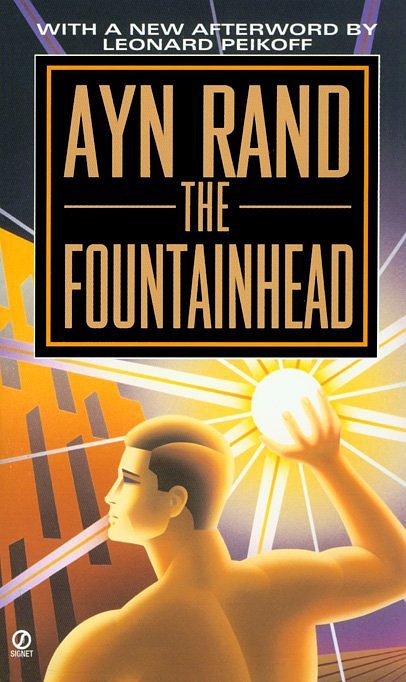
The Fountainhead - by Ayn Rand


Ed: This post was originally made on May 18, 2005 at my blog. This is a reproduction of the same.

Most B-schoolers discover Ayn Rand classic during their MBA preparations. In fact it is probably a matter of prestige for B-schoolers to have 'The Fountainhead' as their favourite book. But I have met quite a few people who call 'The Foutainhead' their favourite just because everyone else does so. By doing so they go against the very philosophy that this book tries to teach. Such people are the living copy of the character - 'Peter Keating'.

Relievingly, I have found many people who have a mind of their own and do not feel ashamed to confess that they either do not understand Rand or the book itself is complete bullshit!

I just completed my 3rd reading of the book. I had failed to complete it 2 times and had to restart every time. After completing the book I felt that the core of the book is the testimony given by Howard Roark (the protagonist of the story) in the court at the end of the story. However, Roark's (or rather Ayn Rand's) ideas are so fundamentally challenging to the dogmas of the society that Ayn Rand had to create a story filled with extremely unnatural characters to explain it.

This is one reason why many people start reading the book but give up in the middle finding the story too absurd or extreme. I myself came very close to being one of such people and know at least two of them.

I feel that such people can read the above mentioned speech and try to understand the concept presented here. I had earlier pasted the text of the speech on my blog but it was too long to be posted here. So I have made good use of my Yahoo! ID which works on all Yahoo! affiliates like geocities by creating a webpage dedicated to Howard Roark's Testimony.

Saturday, June 9, 2007

One Night@Call Center


By Chetan Bhagat


The latest book I read was ‘‘One Night at the Call Center’’ by Chetan Bhagat. The book is not recent, but I had the pleasure of reading it only a few days back. The book is set in one night. The story is about Shyam, Vroom, Priyanka, Radhika, Esha and Military Uncle, working in a Call Center in Gurgaon, who get a call from God one night, which changes their lives.

This book is quite different from Bhagat’s first book Five Point Someone that was about three IIT students. One Night at the Call Center really shows the way Bhagat has grown as a writer, his writing has better flow, and the novel moves at a good pace. It is a real page-turner and once you pick it up you cant put it down till you finish it.

The topic chosen also has a much wider scope than IIT, I mean who goes to IITs now a days, few geeks who have nothing better to do but cram all day for two or more years. But call center is something everybody can easily relate to. Our cousins, friends, and neighbours all work there, and the industry is catering to the job needs of most of our younger generation who have nowhere else to go.

This book presents a morbid picture of the life of call center employs. It tells of the hardships a call center employ has to face in his job, which might be just as cumbersome, or even more, than any other job. The book is real depressing at times but touches your heart with the emotions and the complex network of relationships of the characters. The love story of Priyanka and Shyam is portrayed in quite a realistic and enticing manner.

Although the guys actually working in call centers might not exactly agree with the book, but who cares, the book is great. I finished it in one sitting and that’s something considering I don’t usually sit idle even for ten minutes. The book is an eye opener. The story is so touching that it makes one think and reflect of the hidden truths in life. Things you know but you just don’t have the courage to face. It made me think of the aims I had in my life and whether they were actually what I wanted to get. It made me focus even more strongly on my goals. The experience was enlightening for me and it is a book I’ll always cherish reading.

In short Chetan Bhagat has done a fantastic job with the book and he is one of very few Indian authors who have made a name for themselves in a world dominated by the Haileys and the Archers. Three cheers for you. Keep it up dude, you are doing an excellent job!!!!

Saturday, June 2, 2007

Retire Young, Retire Rich


Robert T. Kiyosaki with Sharon L. Lechter

I have been a fan of Robert Kiyosaki for a while now and so even before writing this review, I know in which direction this is headed.

Firstly I took a long time to read this book , this is not a book which you can just speed read and leave it at that, the main purpose in reading this is to get something of value. Something that you can take home and apply to your life.

Even if I don't get rich or retire young :-) reading this book did give me a different perspective to things. Time and again he speaks about leverage. in fact if you see the Table of contents HERE. You can see that 11 of the 21 chapters have titles beginning with "LEVERAGE" .

This book basically shuttles between his varied experiences over the past 20 years investing in real estate and changes that he had to do in himself and his thinking (or as per the book "Context") to get ahead in life.

I found the first half of the book very interesting, where he exhorts a possibility thinking, so that we do not limit ourselves by our context. I particularly like his way of putting things and dividing people into 4 classes depending on the stream of their income or cashflow> i.e the Cashflow quadrant > which defines whether you are an

1) Salaried employee 2) Self employed

3) Investor 4) Business man

Robert goes on explaining on why it is better to earn income from the latter 2 classes than the former, and why we must try to move to the latter two. Logically speaking he is not too off the mark but only if we had the GUTS.

In general I found this book pretty useful, and infact very motivating, especially some of the examples of real estate investing are really interesting. The latter part of the book was pretty DRAB, where he goes on to explain about the futures and options industry. Also he blatantly advertises his other books time and again in his writings.

If you want to read a scathing review of Robert Kiyosaki and his books have a look here. I do not agree with whatever he has written but it just gives you a counterview. Copy of the original post here.

Monday, May 7, 2007

Johnathan Livingston Seagull


By Richard Bach

This is a beautiful story by Richard Bach. The author is renowned to write short and very inspiring stories. It is also a very concise story, not more than hour’s reading.

The central character of the story is Johnathan Livingston, a very young seagull. He was living with his parents and clan. Most of the seagulls around lived for a single purpose, which was to catch fish. Normally, seagulls fly at a low altitude and slow flight. This helps them to catch fish easily. But Johnathan wanted to fly very high and very fast. This was unusual for a seagull. On trying his whims and wishes, Johnathan was scolded by his parents and ordered to live like a normal seagull.

But he was not able to live this normal life. He started to fly alone, away from his clan. He fine tuned his high altitude high speed sky diving. It was very dangerous and brought him many times near to death. But he continued.

Finally, one day he was able to achieve the speed and altitude he was trying to reach. But suddenly, he found that another seagull flying at more pace and height than him. He was shocked and happy at the same time. Then the faster seagull came to him and told him, that there is no need to be surprised as he doesn’t belong to this world. He further told Johnathan that he belongs to the next world, where all seagulls are passionate for and enjoy high altitude high speed flight. And by achieving the similar credentials, Johnathan has secured his place in the next world. So, Johnathan went to next world.

But Johnathan was not satisfied. His need for speed kept on increasing and he kept on practicing. Every time he achieved the new milestone of flight, he was ushered into the next world. And finally after entering into series of next worlds, he was sent back to his original world, in order to help the young seagulls interested in high speed high altitude flights to enter the next world.

In this story, I learnt the age old lesson though in different manner “Nothing is Impossible”.